
Paying taxes is a part of earning income, but that does not mean you should wait until the end of the financial year to think about your tax liability.
Many people use the terms tax planning and tax saving interchangeably. However, they are not exactly the same.
Tax saving generally focuses on reducing taxable income or claiming eligible deductions and exemptions. Tax planning is broader—it involves looking at your income, investments, expenses, financial goals and applicable tax rules together to make informed decisions.
Understanding this difference can help you make better financial decisions instead of making last-minute investments simply to reduce your tax bill.
What Is Tax Saving?
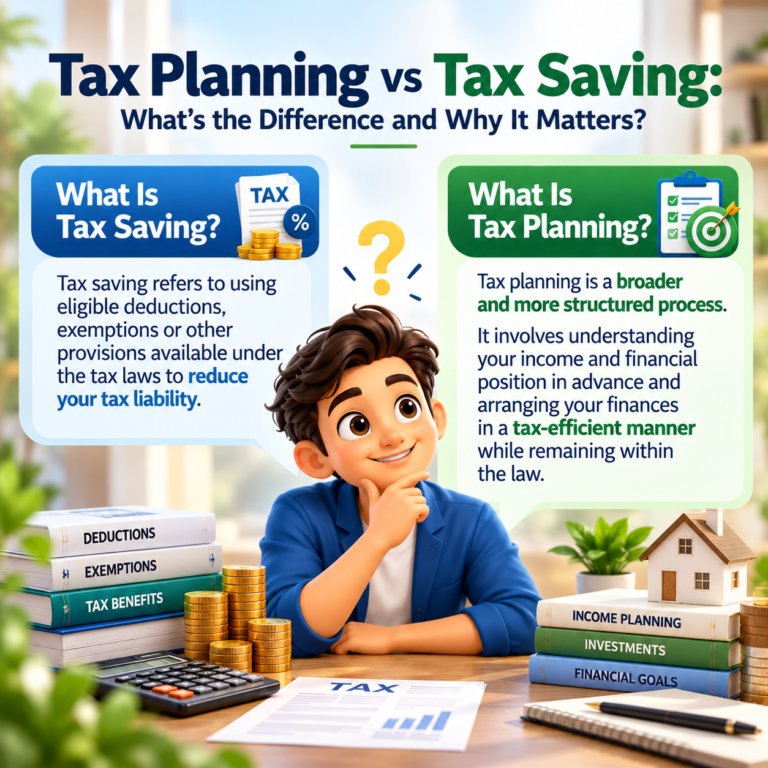
Tax saving refers to using eligible deductions, exemptions or other provisions available under the tax laws to reduce your tax liability.
For example, depending on the tax regime and your eligibility, certain investments, insurance premiums, housing-loan-related payments and other eligible expenses may provide tax benefits.
The important point is that an investment should not be made solely because it offers a tax benefit.
An investment should first make sense for your financial goals, risk profile and overall financial plan.
What Is Tax Planning?
Tax planning is a broader and more structured process.
It involves understanding your income and financial position in advance and arranging your finances in a tax-efficient manner while remaining within the law.
Tax planning may involve considering:
- Your income sources
- Applicable tax regime
- Eligible deductions and exemptions
- Investments
- Insurance
- Retirement planning
- Home loans
- Capital gains
- Financial goals
- Timing of certain financial transactions
In simple terms:
Tax saving asks:
“How can I reduce my tax liability?”
Tax planning asks:
“How can I organise my finances efficiently while considering taxes, investments, risks and financial goals?”
Tax Saving vs Tax Planning
Tax Saving | Tax Planning |
Focuses mainly on reducing tax liability | Looks at the overall financial picture |
Often focuses on eligible deductions and exemptions | Considers income, investments, goals and taxes together |
Can be done for a specific financial year | Ideally begins well before the end of the financial year |
May focus on individual tax-saving instruments | Considers the suitability of different financial decisions |
Primarily tax-focused | Tax + investment + financial-goal focused |
Tax saving can therefore be considered one part of broader tax planning.
Why Does Tax Planning Matter?
1. It Helps Avoid Last-Minute Decisions
A common mistake is waiting until the final months of the financial year and then rushing to make investments because of tax-saving requirements.
This can result in choosing products without properly understanding their risk, liquidity, costs or suitability.
Planning early gives you more time to evaluate your options.
2. It Can Help Align Taxes With Financial Goals
Suppose you need to invest for retirement and are also considering tax-efficient options.
Instead of treating tax saving and retirement investing as two completely separate activities, you can evaluate whether the chosen investment contributes meaningfully to your long-term financial objective.
The goal should be to make your money work toward your financial goals while considering applicable tax rules.
3. It Helps You Compare Tax Regimes
For eligible taxpayers, choosing between the old and new tax regimes can affect the overall tax liability.
The new tax regime is currently the default regime, while eligible taxpayers can opt for the old regime. The Income Tax Department advises taxpayers to compare their tax liability under both regimes and choose according to their circumstances.
Therefore, tax planning should include evaluating which regime may be more suitable rather than automatically assuming that one regime is better for everyone.
Old Tax Regime vs New Tax Regime
One of the important decisions for eligible individual taxpayers is understanding the difference between the two tax regimes.
The old tax regime provides for various deductions and exemptions, subject to applicable conditions.
The new tax regime generally has different tax rates and permits fewer deductions and exemptions. The new regime is the default regime under the current framework.
For example, the Income Tax Department states that several Chapter VI-A deductions available under the old regime are not available under the new regime, subject to specified exceptions.
This is why taxpayers should not decide based only on the number of deductions they can claim. The overall tax liability under each regime should be compared.
The Income Tax Department also provides an Income and Tax Calculator that allows taxpayers to compare tax calculations under the old and new regimes.
Common Tax-Saving Options
Depending on the tax regime and individual eligibility, taxpayers may be able to claim benefits associated with certain financial products and expenses.
Some commonly known areas include:
Life Insurance
Certain eligible life-insurance premiums may qualify for tax benefits under applicable provisions.
However, insurance should primarily be considered for financial protection, rather than simply as a tax-saving instrument.
Health Insurance
Eligible health-insurance premiums may qualify for deductions under applicable provisions when the taxpayer is eligible and the relevant conditions are satisfied.
Health insurance should be evaluated primarily based on the protection it provides rather than just its potential tax benefit.
Retirement and Pension Contributions
Certain eligible contributions toward retirement-oriented products may qualify for tax benefits under applicable provisions.
Retirement planning should nevertheless be based on your expected retirement needs, investment horizon and risk profile.
Home Loan
Home ownership can have tax implications involving eligible principal and interest payments, subject to the applicable provisions and tax regime.
Therefore, buying a home should not be treated purely as a tax-saving strategy. The decision should also consider affordability, loan cost, liquidity and long-term financial goals.
Why Buying an Investment Only for Tax Saving Can Be a Mistake
Imagine an investor says:
“I need to save tax, so I will invest in whatever gives me a deduction.”
This approach can be problematic.
Before investing, ask:
- What is the investment’s risk?
- How long will my money be locked in?
- What returns can reasonably be expected?
- What are the associated costs?
- Does it match my financial goals?
- Do I actually need this investment?
- What happens when the tax benefit is no longer relevant?
A tax benefit should be viewed as one factor in the decision, not the entire reason for making an investment.
Tax Planning Should Start With Your Financial Goals
A better approach is to begin with your overall financial plan.
For example:
Goal: Retirement
↓
Required corpus: Estimate the amount needed
↓
Investment strategy: Select suitable investments
↓
Tax consideration: Evaluate applicable tax benefits
↓
Review: Reassess periodically
This approach ensures that taxation is considered as part of financial planning rather than becoming the sole reason for investing.
A Simple Example
Consider a salaried individual who has several financial goals:
- Building a retirement corpus
- Protecting the family through insurance
- Creating an emergency fund
- Saving for a child’s education
- Managing annual tax liability
Instead of waiting until the end of the financial year and making random tax-saving investments, the individual can plan these requirements throughout the year.
For example:
Step 1: Determine financial goals.
Step 2: Estimate the amount required for each goal.
Step 3: Identify suitable financial products.
Step 4: Understand the applicable tax treatment.
Step 5: Compare the old and new tax regimes where relevant.
Step 6: Review the plan periodically.
This is much closer to tax planning than simply trying to save tax at the last moment.
Common Tax Planning Mistakes
Waiting Until the Last Minute
Last-minute decisions can lead to unsuitable investments.
Investing Only to Save Tax
A tax deduction does not automatically make an investment suitable.
Ignoring the New Tax Regime
Since the new regime is the default regime, eligible taxpayers should understand how their tax liability compares under both regimes.
Ignoring Investment Risk
Tax benefits should never make you ignore the risk associated with an investment.
Forgetting Liquidity
An investment may provide a tax benefit but still be unsuitable if you need access to the money in the short term.
Not Reviewing the Plan
Changes in income, investments, expenses and tax rules can affect your overall tax position.
How to Build a Better Tax-Planning Strategy
A simple approach is to follow these steps:
Step 1: Understand Your Income
Identify your salary, business income, investment income, rental income and other applicable sources.
Step 2: Review Your Existing Investments
Understand what you already own before making new investments.
Step 3: List Your Financial Goals
Separate short-term, medium-term and long-term goals.
Step 4: Evaluate Your Tax Regime
Compare the applicable tax liability under the old and new regimes based on your circumstances.
Step 5: Identify Relevant Tax Benefits
Check which deductions or exemptions you are actually eligible for.
Step 6: Choose Investments Based on Overall Suitability
Consider risk, return expectations, liquidity, time horizon, costs and financial objectives—not just tax benefits.
Step 7: Review Periodically
Tax planning should be an ongoing process rather than something done only before filing your income-tax return.
Tax Planning Is Not Tax Avoidance
It is important to understand the difference.
Tax planning involves making legitimate financial decisions within the applicable tax laws.
Tax avoidance/evasion can involve arrangements or actions that do not comply with the law.
The objective of tax planning should always be to manage your finances efficiently while remaining compliant with applicable tax rules.
The Bottom Line
Tax saving and tax planning are related, but they are not the same.
Tax saving focuses mainly on reducing tax liability through eligible deductions, exemptions and provisions.
Tax planning takes a broader view by considering your income, investments, financial goals, risk, liquidity and applicable tax rules together.
The best approach is not to ask:
“Which investment will save me the most tax?”
Instead, ask:
“Which financial decisions help me achieve my goals while also being tax-efficient?”
Starting early, understanding the applicable tax regime and reviewing your financial plan regularly can help you make more informed decisions.
Remember that tax rules can change, and the applicability of deductions or benefits depends on individual circumstances and the relevant provisions for the applicable financial year.
Disclaimer: This article is for educational and informational purposes only and should not be considered tax, legal, investment or financial advice. Tax laws, rates, deductions and eligibility conditions may change. Taxpayers should verify the applicable provisions for the relevant financial year and consider professional advice where appropriate.